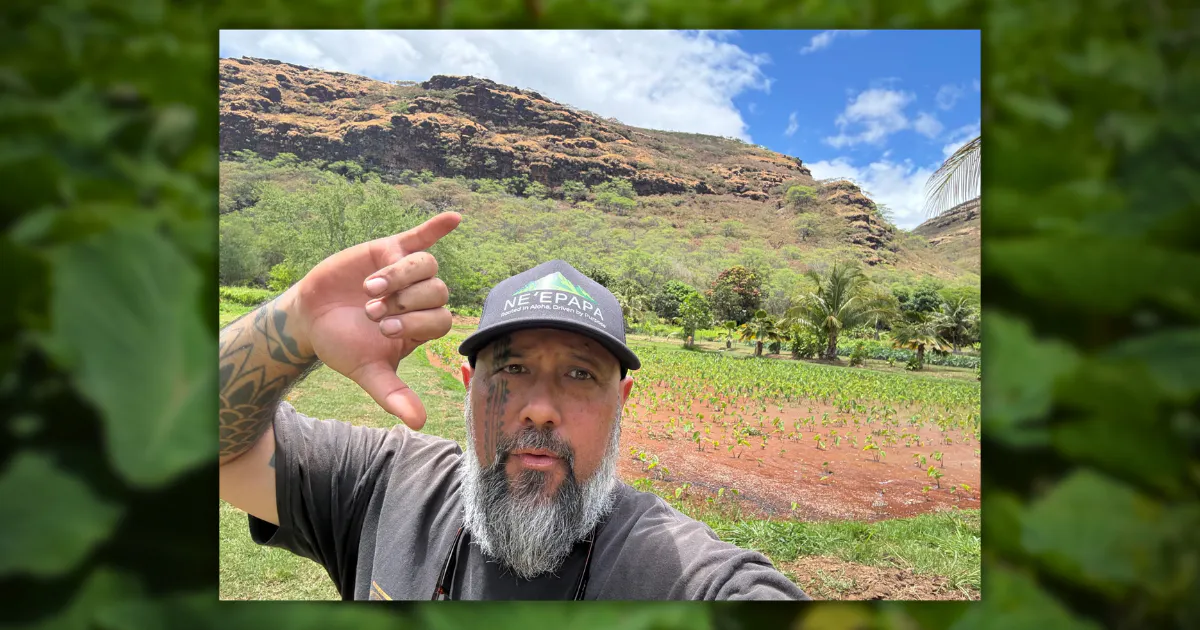
Photo courtesy Babā Yim
The Immersive Huakaʻi is a defining experience in the Omidyar Fellows program. Guided by mentors and grounded in purpose, each Fellow journeys into a community whose work reflects the future they hope to help create for Hawaiʻi. The experience is an opportunity to listen deeply, learn from others, and return with new insights to share.
By: Babā Yim
As we say our goodbyes to these last days of summer, I anxiously await the next time that I am sitting in the same room as the rest of my cohort ʻohana because I know it will be a time for us to share all of the adventures had and lessons learned from each of our individual “Leadership Huakaʻi.” I can’t wait to hear all of the moʻolelo that my friends have to share. I know they will be filled with joy, growth, and new learning.
On my Leadership Huakaʻi, which I have called, “He aha ia mea he alakaʻi?” (What is this thing we call a leader?), I spent time with four people that I consider “alakaʻi”, or leaders in their respective fields of society in Hawaiʻi today. They are Hiapo Perreira, ʻŌlelo Hawaiʻi/Hawaiian Knowledge; Keʻalohi Reppun, Hawaiian Education; Kaina Makua, Aloha ʻĀina; and Keola Nakaʻahiki, Entrepreneurship and Community Engagement.
During these visits, I asked them questions that helped me uncover their manaʻo on what leadership means from perspectives deeply rooted in Hawaiʻi. I was looking for insights from their various points of view, hopeful that somewhere at their intersection would be some kind of answer to the question driving my huakaʻi. For those of you on the edge of your seat right now waiting for the secret, I’m going to let you down easy and just say there is none. But I can say with all honesty that I am much closer to the answer than I was before this journey began. What I did find are some recurring themes that emerged throughout all of my conversations. While there were a number of interesting thoughts that these leaders had in common, I’ve picked a few that I feel could be of value to us as leaders in the communities we serve.
Pilina — Relationships In Leading
Pilina is the lifeblood of Hawaiʻi leadership. All of the leaders I sat with identified relationships and connection as two of the most important aspects of being an alakaʻi for Hawaiʻi.
Connection to ʻāina grounds us in purpose no matter what we do. From the executive boardroom to the loʻi, there is one inescapable truth—if the ʻāina is thriving, so are the people. No matter where we lead from, we must cultivate and nourish our connections to ʻāina, wai, and kai. These connections will in turn feed our communities and families, making a Hawaiʻi that we can proudly leave for the next generation who can continue when our turn here is done.
Connection to community fuels the work we do in whatever sector of society we operate. By definition, a leader serves people around them so pilina to our communities, and how we take care of them is one of the cornerstones of any alakaʻi. Create new connections within your community and strengthen existing ones every chance you get.
Connection to family keeps us grounded as people. Whether related by blood or the family we choose to build around us, those ties give us purpose and safe harbor in a position that at times can be excruciatingly lonely. While the jobs we do as leaders are often ones that others can’t do for us, do not lead alone. Keep your keiki in your heart and your kūpuna at your back to push you always forward.
Kuana ʻIke — Perspective and Positionality In Leading
The word kuana in Hawaiian literally means position or standing. It is the space occupied by your two feet at any given time. When combined with the ʻike, which is sight or knowledge, it creates the term kuana ʻike. This word speaks of how you see everything and experience the world from where you stand. It is your perspective and worldview. While many may have similar kuana ʻike, no two people have the exact same one. That is the important part to remember.
What I learned about kuana ʻike is to know and be comfortable with yours, but also be curious and thoughtful when learning others’. Other people’s perspectives on issues can only help to inform yours, even if in direct opposition. They add pixels to the “big picture” we strive to see as leaders and many times can turn the blurry black and white image we have of a situation into full color, high definition 5K that might hold an answer that we initially failed to see.
The other thing I learned related to this is about positionality in leading. A dynamic leader is one that can inspire forward motion in their group from any position. As is the standard, one dimensional definition of leadership tells us, that may call for the traditional method of standing in front of the group giving commands or direction. Other times it will require us to step aside and lead from behind, allowing our team to use their talents and gifts to get things done. Even more complex and nuanced, is for a leader to lead from the middle or within the group. In this way, when observing from outside, it is sometimes difficult to identify who the leader actually is as the group moves together guided from within. Having conversations about this idea of understanding positionality in leadership was fascinating to me and one I intend to explore more deeply as my journey evolves.
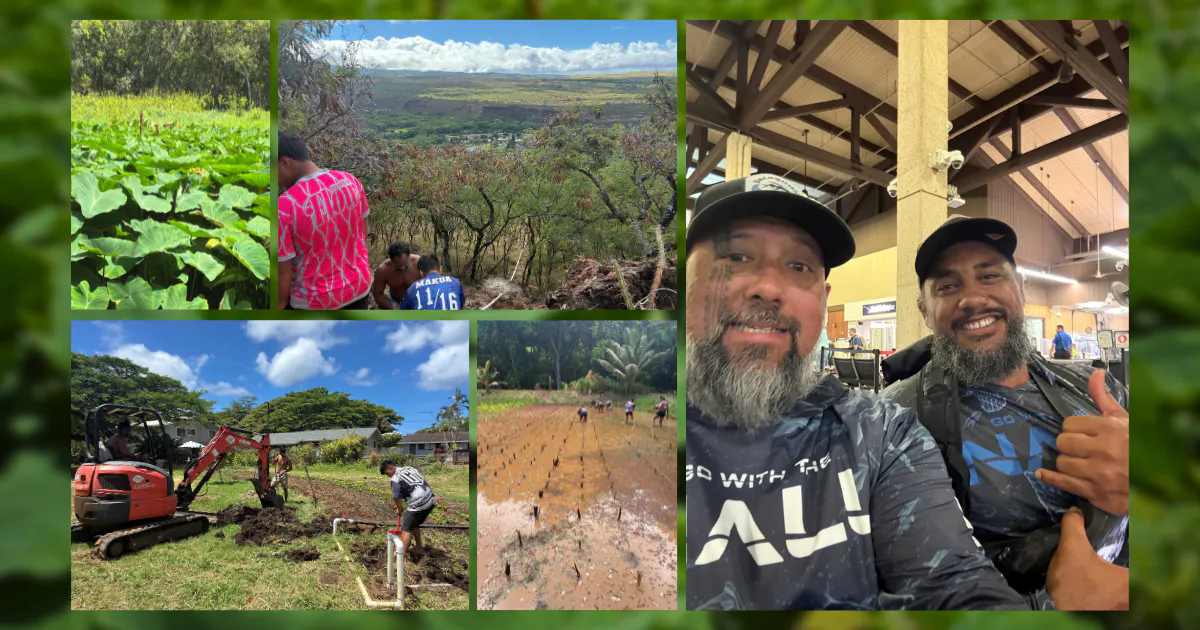
Photos courtesy Babā Yim
ʻUhane — Spirit in Leading
One of the most amorphous concepts for leaders to grasp is the cultivation of spirit or ʻuhane as leaders. This is one of those things that looks and feels different for everyone. It is invisible, yet guides so much of what we do, sometimes without us even realizing that it is there. For some it is a firm religious belief that a higher power is directing our every move, for others it is feet firmly planted in the life giving mud of the loʻi kalo as we find clarity for the challenges of the day. It is the feeling in your naʻau to choose one path and not another. It is the tingle you feel on the back of your neck before you are in danger of making a bad decision. It is intuition. It is our gut instinct. Call it what you will; there are many names for the same thing. I call it ʻuhane.
While some dismiss spirit and say it doesn’t have a place in leadership, I respectfully disagree. It is something that when we shut our mouth for long enough, we will hear its quiet whisper underneath all the noise showing us the way. It can give us signs when we are right and will definitely let us know when we are wrong. It is a constant companion that if cultivated, we can call upon to help us through tough times and even tougher decisions. I cannot presume to tell anyone what ʻuhane looks like for them, but all the leaders I spoke with rely on some form of ʻuhane in their leadership to guide them in being of better service to others around them. The lesson I learned is to get in touch with what spirit looks like for you and embrace it. Allow yourself the space and the grace to water it and let it grow. Sit in silence, its voice will meet you there.
Self-Care in Leading
One final manaʻo that resonated throughout my conversations with the alakaʻi I sat with during my huakaʻi was taking “good” care of yourself as a leader. It is no secret that as leaders, many times we give of ourselves until we have nothing left. We make sure others have all of us, sometimes to the point of not having anything left for ourselves or our families. This is something that needs constant attention if we hope to be long-lasting, effective alakaʻi for the future of Hawaiʻi. We are no good to those we serve if we are running on empty and have nothing to give.
One of my mentors of many years shared with me the idea of “one, few, many,” which goes: we strengthen ourselves and sharpen all of the skills to make us the best individuals so we can be the “one.” We then rely on a “few” close to us with similar beliefs and values to push forward with the mission. Finally, we take our collective knowledge and skills and use them to serve the “many.” This works in any organization, in all kinds of settings, except if the “one” is not at their best. This whole system falls apart if the “one” is depleted and never takes the time to recharge.
All of this to say, self-care is not selfish. Making sure your mind, body, and spirit are well cared for is a true investment into your longevity and effectiveness as an alakaʻi. So take those moments to sit in silence when you need them, go climb a mountain, swim in the sea, learn something new, or most of all, be present for your keiki and family. Be that fully functional, dynamic leader you are meant to be each and every day you show up to serve.
These thoughts are just of a few of the gems that were so generously shared with me during my huakaʻi this summer. I am very thankful for the opportunity to have gone through the process of imagining, planning, and finally completing this journey. I know that for me, this was just the first step on a path that will continue to unfold throughout my lifetime. I also want to express my heartfelt gratitude to the four true alakaʻi who took the time and shared so much aloha by allowing me a glimpse into their lives and thoughts as Hawaiʻi leaders. While they are all dear friends of mine, I will treasure this special time spent with them and the opportunity to learn more about leadership from a “Hawaiʻi” perspective.
This story appears in the July/August 2026 issue of Taking on Tomorrow.
Suzanne Skjold shares about a yearlong experiment with CivicNexus, an AI-powered bill tracking platform, and how shared technology and building community can boost cross-organization collaboration and expand legislative engagement.